
Hey there, dreamer of a straighter smile! Cleona Dental’s Invisalign service offers discreet teeth straightening with clear aligners. Say goodbye to traditional braces and hello to achieving your dream smile without the fuss.

Invisalign is a system of clear, custom-made plastic aligners that gradually move your teeth into position. Instead of brackets bonded to your teeth and wires tightened every few weeks, you wear a smooth removable tray that covers your teeth and applies gentle, controlled pressure.
Each set of aligners is worn for about a week or two before you move to the next one in the series. Every tray is slightly different from the last, and over the course of treatment those small changes add up to a straighter smile.
The trays are thin and nearly invisible from a conversational distance. Most people who go through treatment tell us that coworkers and acquaintances never noticed they were wearing them at all.
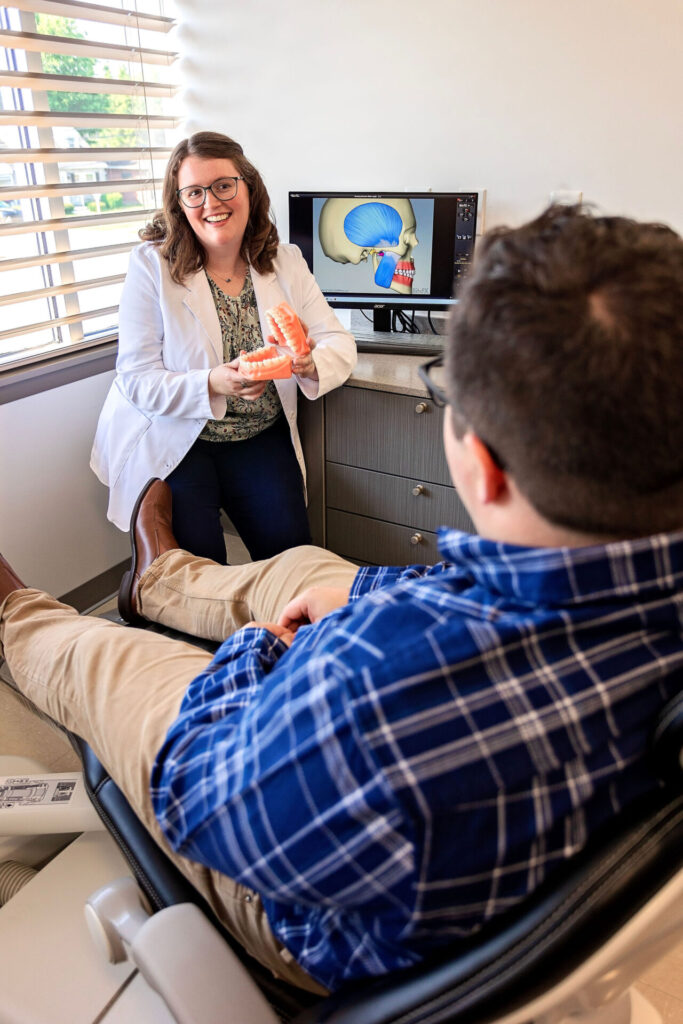
We start with a conversation, not a sales pitch. We’ll look at your teeth, ask what specifically bothers you about your smile, examine how your bite comes together, and tell you honestly whether clear aligners are the right tool for what you want to accomplish. If they aren’t, we’ll say so.
If you move forward, we take a digital scan of your teeth along with photos and any necessary X-rays. No trays of impression material. The scan builds a precise 3D model of your mouth.
Using that model, we map out exactly how your teeth will move and in what order. You’ll get to see a digital preview of the projected result before a single aligner is made, along with an estimate of how long treatment should take.
Your custom aligner series is manufactured and shipped to our office. We’ll fit the first set, show you how to insert and remove them, and make sure you’re comfortable before you leave.
You’ll wear your aligners about 20 to 22 hours a day, removing them to eat, drink anything other than water, brush, and floss. Every week or two you’ll advance to the next set on the schedule we give you.
We’ll see you periodically to confirm your teeth are tracking the way the plan projected and to hand off your next batch of aligners. These visits are short.
Once your teeth are where you want them, you’ll wear a retainer to hold them there. Teeth have memory and will drift back over time without one. This step is not optional, and we’ll talk through what retention looks like long before you finish.
Clear aligners handle a wide range of alignment and bite issues, including:
Complex cases involving significant skeletal issues or severe rotation may be better served by traditional braces or an orthodontic referral. We’ll tell you which category you fall into at your consultation.
Both work. They just work differently, and one may fit your life better than the other.
Aligners are clear and removable. Braces are fixed and visible, though modern brackets are smaller and less obtrusive than they used to be.
With aligners you take them out and eat whatever you want. With braces there’s a real list of foods to avoid: popcorn, hard candy, nuts, corn on the cob, sticky caramel.
Aligners come out, so you brush and floss normally. Braces require threading floss under wires and working around brackets, which is why we see more decalcification and gum inflammation in braces patients.
Aligners are smooth plastic. Braces involve brackets and wires that can irritate the inside of the lips and cheeks, especially in the first weeks and after adjustments.
Aligner checkups tend to be shorter and less frequent than the wire adjustments braces require.
This is the real trade-off. Braces work whether you’re motivated or not, because you can’t take them off. Aligners only work if you actually wear them 20 to 22 hours a day. If you know you’d leave them sitting on the nightstand, braces may genuinely be the better choice, and there’s no shame in saying so.
Aligners handle a large share of cases very well. Certain severe rotations, significant bite corrections, and skeletal discrepancies are still better addressed with fixed appliances.
Wear time is the whole ballgame. Twenty to twenty-two hours a day. That leaves you roughly two to four hours for meals and oral care. Most people settle into a rhythm within the first week or two.
Eating and drinking. Aligners come out for everything except plain water. Coffee, tea, wine, and soda will stain the trays and can trap sugar and acid against your enamel. Rinse before putting them back in.
Cleaning your aligners. Rinse them every time they come out and brush them gently with a soft brush and clear, unscented soap or a designated cleaning product. Skip toothpaste, which is abrasive and clouds the plastic, and skip hot water, which can warp it.
The first few days of each new tray. Expect a feeling of tightness or pressure for a day or two after switching. That’s the aligner doing its job. Many people switch trays at bedtime so the adjustment period happens while they sleep.
Speech. A slight lisp for the first few days is common and almost always resolves quickly as your tongue adapts.
Travel, sports, and photos. Aligners travel easily. Take them out for contact sports and wear a mouthguard instead. And yes, you can take them out briefly for a wedding photo or a presentation, as long as it doesn’t become a habit.
One practical warning: never wrap an aligner in a napkin at a restaurant. It is the single most common way they get thrown away. Carry the case.
Clear aligners tend to be a strong fit for:
They may not be the right choice if:
We’d rather tell you at the consultation that aligners aren’t the right fit than take you halfway through a treatment that was never going to get you where you wanted to go.
Bite comes first. Dr. Jennifer Davis completed her training at the Pankey Institute, where the focus is on how the whole system fits together: how your teeth meet, how your jaw functions, and how the two affect each other over a lifetime. Straightening teeth without accounting for the bite can create new problems down the road. We plan for both.
You’re treated by the dentist who knows you. Your Invisalign treatment happens in the same office, with the same team, that handles your cleanings and checkups. We already know your history, and there’s no handing you off to a practice that’s never seen you before.
Honest recommendations. Aligners are not the answer to every case, and we’ll tell you plainly if you’d be better served by braces or a referral to an orthodontist.
No judgment about where you’re starting from. Whether you’ve been unhappy with your smile since high school or your teeth shifted after twenty years without a retainer, we’ve heard it, and there’s nothing to be embarrassed about.
It depends entirely on how far your teeth need to move. Minor corrections can finish in a matter of months, while comprehensive cases take considerably longer. We’ll give you a projected timeline at your consultation, before you commit to anything.
Most people describe pressure or tightness rather than pain, concentrated in the first day or two after switching to a new tray. Over-the-counter pain relief is rarely necessary but does help if you want it.
Rarely, at normal conversational distance. This is the main reason adults choose aligners over braces.
Occasionally, yes. Every hour they’re out is an hour they aren’t working, so it should be the exception rather than the routine.
Call us right away. Depending on where you are in the series, we may have you move to the next tray early or wear the previous one while a replacement is ordered. Don’t just leave it out.
Many treatment plans include small tooth-colored bumps bonded to certain teeth, which give the aligners something to grip so they can produce specific movements. They’re removed at the end of treatment and are far less noticeable than braces brackets.
Yes. Teeth drift back toward their original positions without retention. This is the single most common reason people end up needing treatment twice.
Often, yes. The deciding factor is usually maturity and wear-time discipline rather than age. We’re happy to give you an honest read on whether your teen is a good candidate.
This is one of the most common cases we treat. Aligners frequently handle post-braces relapse very well.
No, but you do have to take your aligners out to drink it and rinse before putting them back in. Coffee stains the trays and traps acid against your teeth.
The first step is a conversation. Come in, tell us what you’d like to change, and we’ll give you a straight answer about whether clear aligners will get you there.
New patients: (717) 524-5369 | Current patients: (717) 272-8500